Updated November 2026 · By the Wayfold team at Honest Little Apps · Scripture: World English Bible (public domain), from ebible.org
What is the difference between SOAP and inductive Bible study?
SOAP (Scripture, Observation, Application, Prayer) starts from one verse and moves quickly to “what does this mean for me today.” Inductive Bible study (Observation, Interpretation, Application) starts from a whole passage and slows down on what the text actually says before asking what it means or how to live it. SOAP is faster; inductive goes deeper.
SOAP was created by Pastor Wayne Cordeiro of New Hope Christian Fellowship in Honolulu and set out in his 2007 book The Divine Mentor, according to Christianity.com. The inductive method is taught by Precept Ministries, whose study method page lists its three steps as observation, interpretation and application, with observation including the “5 W's and an H,” marking key words, and noting time and places.
SOAP asks “what is God saying to me?”; inductive first asks “what does it say?”
SOAP vs inductive, side by side
| SOAP | Inductive | |
|---|---|---|
| Steps | Scripture, Observation, Application, Prayer | Observation, Interpretation, Application |
| Unit | One verse or a few | A paragraph, chapter or book |
| Time | 10–20 minutes | 30–60 minutes or more |
| Tools | Bible, journal | Bible, pens, a notebook; a map helps |
| Strength | Daily habit, prayerful | Context, accuracy |
| Risk | Verse lifted out of its story | Stalls in notes, never applied |
| Best for | Morning quiet time | Leading a group, hard passages |
Time ranges are our own estimates from running both methods on Ruth 1, not published figures.
Use SOAP to keep the habit; use inductive when the habit has gone thin.
Ruth 1, worked both ways
The verse most people SOAP from Ruth 1:
Ruth said, “Don’t urge me to leave you, and to return from following you, for where you go, I will go; and where you stay, I will stay. Your people will be my people, and your God my God.Ruth 1:16, WEB
SOAP (12 minutes)
- Scripture
- Copy Ruth 1:16 into the journal.
- Observation
- Ruth refuses to leave Naomi.
- Application
- Stay loyal to my family this week, even when it costs.
- Prayer
- “Lord, make me faithful like Ruth.”
Inductive (40 minutes)
- Observe
- Naomi tells her daughters-in-law to go back three times (verses 8, 11 and 12). Orpah kisses her and leaves; Ruth “stayed with her” (14). Verse 16 ends with “your God my God.” Verse 22 says they arrived “in the beginning of barley harvest.”
- Interpret
- Ruth's choice is not only loyalty to a person; it is a turn to Israel's God, and it comes after three refusals. The barley harvest at the end is a quiet signal of what chapter 2 is about.
- Apply
- Loyalty that has counted the cost three times is different from a feeling. Where am I being told “go back”?
Both are honest readings. The inductive one simply had more of the chapter to work with, so its application is sharper.
The verse was the same; the chapter around it changed what we saw.
Try a 20-second inductive drill
This is how Wayfold's “Find the verse” works: you get a question, then tap the line in the chapter that answers it. Here are five lines from Ruth 1 (WEB).
Inside Wayfold
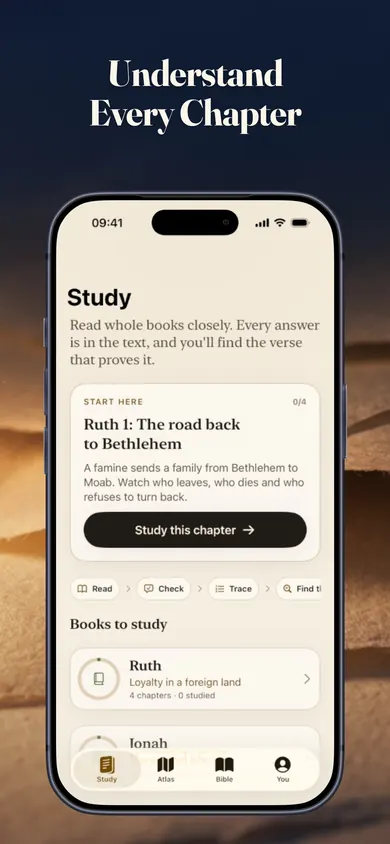
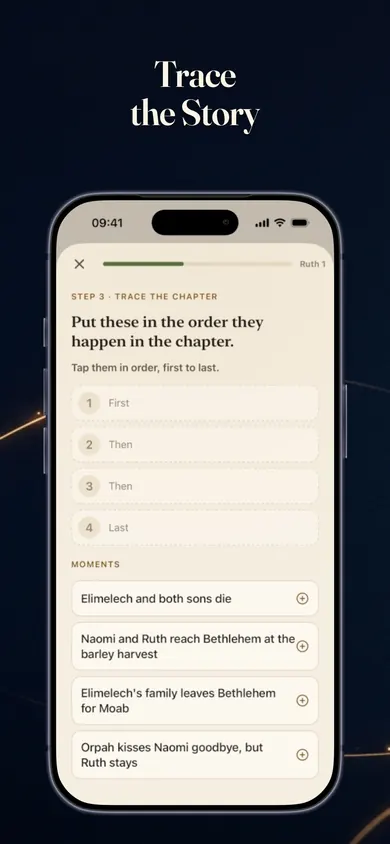
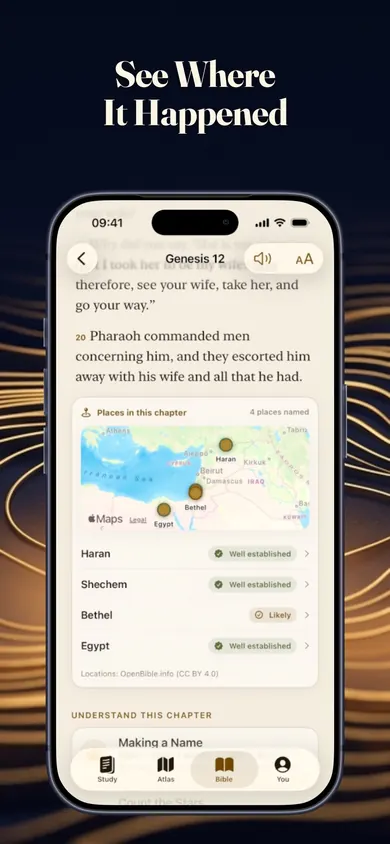
Wayfold is built around the observation step. Read the full chapter in the World English Bible, answer a few questions, then see the exact words in the chapter that answer each one. Go deeper notes are labeled as what the text says, history, interpretation or debated, so you know which is which. Ruth and Jonah, with their printable leader guides, are free; Philippians, James, Habakkuk and Philemon come with a one-time Premium Lifetime purchase. Nothing renews.
SOAP vs inductive FAQ
Is SOAP an inductive Bible study method?
Not quite. SOAP borrows the observation step but moves to application after one verse, so it skips most of the slow work on context that inductive study is known for. You can make SOAP more inductive by reading the whole chapter before picking your verse.
Which method is better for beginners?
SOAP is easier to start and to keep daily. Try the inductive method once a week on a short book like Ruth, which has four chapters, so you build the skill without losing the habit.
Can I use both methods together?
Yes. A common pattern is SOAP on weekdays and one inductive session on the weekend on the same chapter. The weekend session often corrects or sharpens what you wrote during the week.
What is the best book to practise inductive study on?
Pick a short narrative book. Ruth and Jonah each have four chapters, a clear story and named places, which makes the who, what, where and when questions easy to answer.
Who should pick something else
- If you want a daily journaling prompt and nothing else, a paper SOAP journal is cheaper and simpler than any app.
- If you need original-language tools (Hebrew and Greek lexicons, parsing), use a dedicated Bible software package. Wayfold's language notes are short and plain.
- If your group follows a set curriculum, stick with it; Wayfold's leader guides cover six books only.
Start on your iPhone
Open Ruth 1 tonight. It's free, read aloud if you like, and every answer points to the verse that proves it.
Keep reading
- Book of Ruth summary by chapter, on a timeline from empty to fullA Book of Ruth summary by chapter on a timeline from famine to harvest, with the WEB verse behind each point and a calculator for reading or group time.
- How to use a Bible commentary without letting it do your thinkingHow to use a Bible commentary without letting it do your thinking: 3 taps build a timed study order, plus a worked example on Jonah 4:2 (WEB).
- Book of Jonah summary by chapter, with the verse behind each pointA Book of Jonah summary by chapter, with the verse behind every point, labeled notes on history and debate, and a drag-to-order quiz of the story.
- How to prepare to lead a Bible study: the night-before checklistA 12-item checklist for small-group Bible study leaders, from reading the chapter to the last question, with a progress ring that saves as you go.