By Honest Little Apps, the small studio behind Wayfold. Scripture is quoted word for word from the World English Bible (public domain).
How do you use a Bible commentary?
Use a Bible commentary after you've read the passage and written your own observations and questions, not before. Read the text twice, note what it says, list what you don't understand, then open the commentary to answer those questions. Check every claim it makes against the verses themselves, and treat it as one scholar's view.
That order isn't just our opinion. Matthew Boffey, writing for Logos in September 2021, put it plainly: "When you come to a commentary without any of your own thoughts on the text, the commentary will do your thinking for you." Jay Sklar's list of five ways to misuse a commentary (Crossway, December 2018) includes starting with the commentary instead of the Bible, and treating it as if it can't be wrong.
The Bereans in Acts 17:11 are the model most Bible teachers point to: "Now these were more noble than those in Thessalonica, in that they received the word with all readiness of mind, examining the Scriptures daily to see whether these things were so." They listened carefully, then checked.
The text first, your questions second, the commentary third.
Four kinds of commentary
Commentaries aren't one thing. Pick the kind that fits the question you're asking.
Logos sorts commentaries along similar lines, matching critical commentaries to textual questions, expository ones to interpretive questions, and theological or application commentaries to questions about doctrine and life.
Match the commentary to your question: notes for context, expository for meaning, technical for hard words.
One question, worked through
Here's the method as a conversation, on the question everyone asks about Jonah.
This is where a commentary earns its place: background on Nineveh as a great city of Assyria, a power that threatened Israel, and why an Israelite prophet might resent its rescue. Note the labels. The history is checkable. The reason in Jonah's heart is an interpretation, and good commentaries say so.
Read until the text answers what it can; then let the commentary answer what the text assumes you already know.
A Thursday night, sketched
This is an illustration, not a testimonial. A small-group leader has Jonah 4 on Sunday. Old habit: open three commentaries and read for an hour. New habit: twelve minutes in the chapter, three questions on an index card, and one commentary for twenty minutes, only on those three. Sunday, the group finds the Exodus 34:6 echo themselves because she asked the right question, not because she lectured it.
The method in three steps
Read and observe
Read the passage twice. Write down who, what, where and any repeated words. Don't interpret yet.Write your questions
List what you don't understand. Bring specific questions; they tell you where to look in the commentary and keep you from skimming.Consult, then check
Open one commentary for your questions. For every claim, ask: is this in the text, history, or interpretation? Then go back to the verses.
Observe, ask, consult, check. In that order, every time.
Where Wayfold fits
Wayfold is built around this order. You read the full chapter in the World English Bible first, answer a few questions about what happened, then see the exact words in the chapter that answer each one. Go-deeper notes on history, language and meaning come after, and each one is marked as what the text says, history, interpretation or debated.
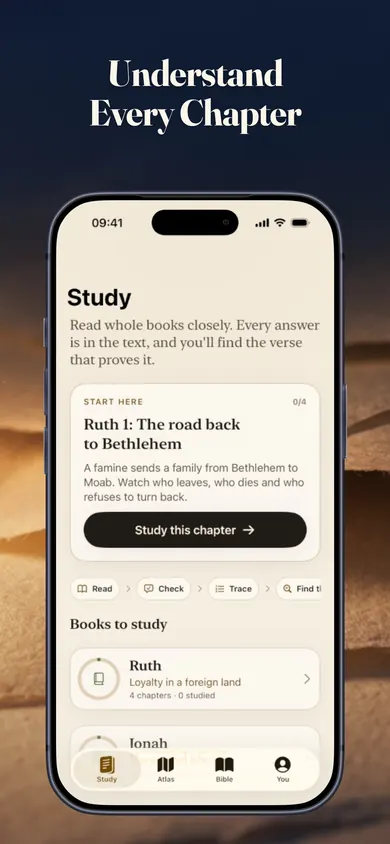
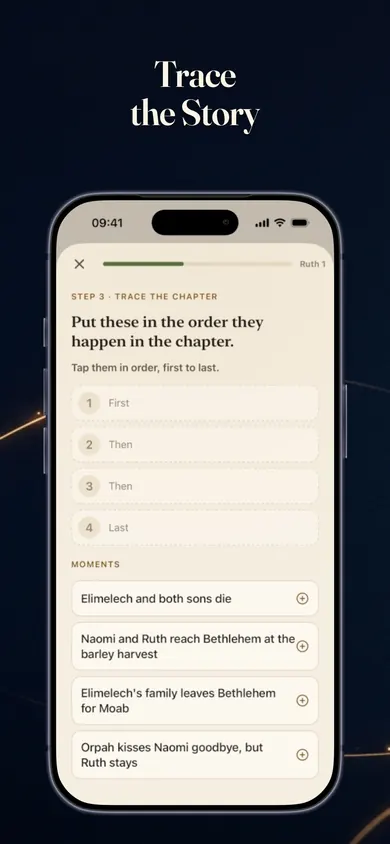
One design decision: nothing is generated while you use Wayfold, and every quotation is checked against the bundled Bible text. Sources are named for history and language notes.
Honest limits
- Wayfold is not a commentary. Its notes are short and labeled; it won't replace a full expository or technical commentary on a book.
- Six study books. Ruth and Jonah studies and their printable leader guides are free, along with the full Bible reader, read-aloud and search. Philippians, James, Habakkuk and Philemon come with Premium Lifetime, a one-time purchase with no subscription.
- Labels aren't verdicts. "Interpretation" and "Debated" tell you to check other voices, not which one is right.
Who should pick something else
- If you're preparing a sermon on a book Wayfold doesn't cover, you need a full commentary set and probably original-language tools.
- If you want devotional reading, not study, a daily devotional will suit you better than chapter questions.
- If you mainly need free online commentaries, your church library or a public-domain commentary collection is the place to start.
Read it yourself first. Open Wayfold in the App Store
Start free with Ruth and Jonah, including their printable small-group leader guides. No account, no ads, no tracking.
- Book of Jonah summary by chapter, with the verse behind each pointA Book of Jonah summary by chapter, with the verse behind every point, labeled notes on history and debate, and a drag-to-order quiz of the story.
- How to prepare to lead a Bible study: the night-before checklistA 12-item checklist for small-group Bible study leaders, from reading the chapter to the last question, with a progress ring that saves as you go.
- Book of Ruth summary by chapter, on a timeline from empty to fullA Book of Ruth summary by chapter on a timeline from famine to harvest, with the WEB verse behind each point and a calculator for reading or group time.
- SOAP vs inductive Bible study, worked on Ruth 1SOAP vs inductive Bible study, compared on one passage: Ruth 1 worked both ways, a side-by-side table, and a 20-second find-the-verse drill to try.